

FIGHTING FOR PRINCIPLES, NOT JUST PRODUCTS
PROTECTING YOUR RIGHT TO COMMERCIAL FREE SPEECH
When New York banned the sale of dietary supplements marketed for weight loss or muscle building to anyone under 18, the law threatened far more than products making certain claims. At stake: the fundamental right to make truthful, science-based claims about legal products—a key component of commercial free speech.
If government can silence truthful claims without evidence that such restrictions actually advance public health, no marketing message is safe. No label claim. No scientific validation. Today it’s sports nutrition; tomorrow it could be any category of claim based on opinion or emotion rather than facts. That’s why CRN is continuing its litigation in New York to repeal the state’s age restriction law.
The law improperly uses truthful product claims as a stand-in for evidence of harm—a dangerous precedent that threatens the entire industry’s ability to communicate benefits.
“While we are disappointed in the court’s decision not to halt enforcement at this stage, we remain confident in the strength of our constitutional challenge. This law improperly targets truthful, lawful marketing claims about dietary supplements and represents a troubling attempt to regulate speech, not product safety.”
— CRN SVP and General Counsel Megan Olsen
A GOOD START, BUT NOT ENOUGH: INNOVATION VS. MONOPOLY
Drug preclusion—the federal statutory provision preventing supplement companies from using ingredients that are approved as a drug or under pharmaceutical investigation—has long created unfair competitive advantages for the drug industry.
Though FDA responded to industry petitions, including one filed by CRN, on drug preclusion by allowing NMN back into the market—a narrow victory—the agency declined to address the structural imbalance in the law that prevents fair competition.
FDA persisted in upholding an interpretation of drug preclusion that allows confidential dates to govern when preclusion takes effect. These secret investigational new drug filing dates, mean supplement companies don’t know when the “race to market” begins. By the time it’s discovered an ingredient is precluded, years of dietary supplement research and marketing investment may be wasted, affecting potentially dozens of ingredients.
CRN is now developing legislation to provide clarity and restore fairness to protect supplement innovation.
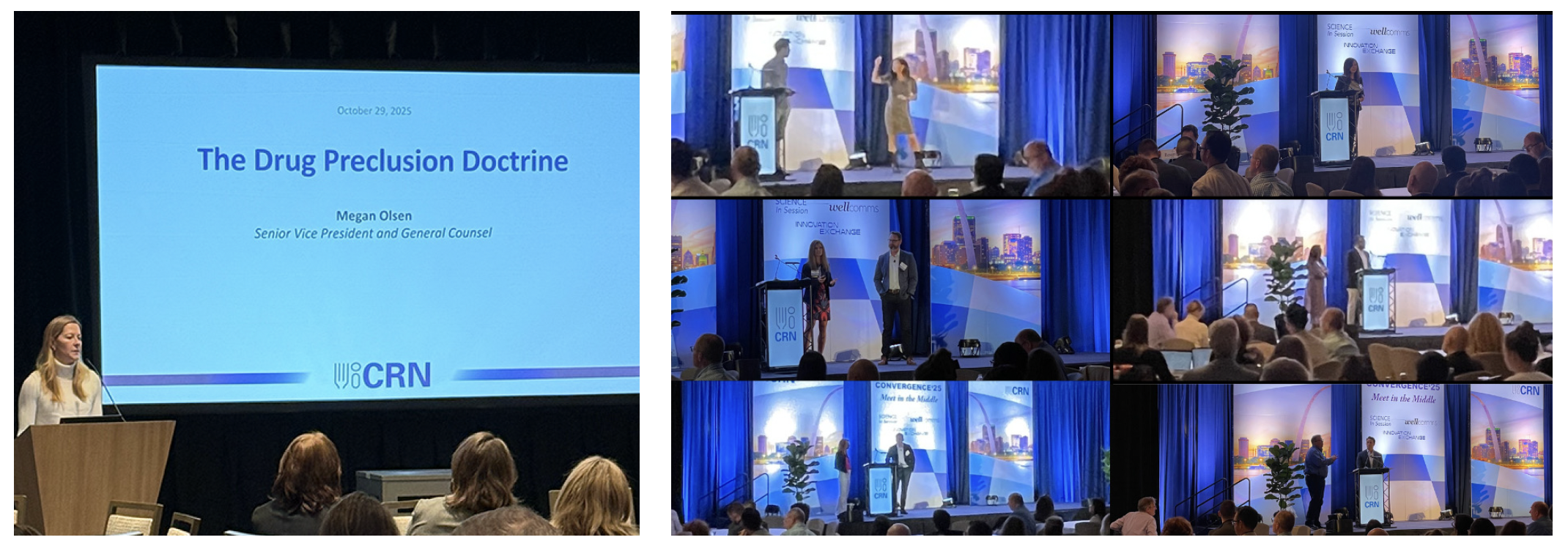
Megan Olsen, SVP and General Counsel, leading the team’s New York state age restriction litigation efforts in consultation with law firm Cozen O’Connor, shared updates on the case during the CRN Member Breakfast Briefing at SupplySide Global as well as the drug preclusion issue and CRN’s efforts to secure revisions to FDA’s ”DSHEA disclaimer.” Also pictured, CRN’s second annual “Innovation Exchange” event, featuring steering committee-selected presentations on cutting-edge ingredients and technologies.
SCIENCE, STANDARDS & RAPID RESPONSE
