
APR – JUNE 2026
Quarterly Results Report
In Q2, the Council for Responsible Nutrition (CRN) advanced science-based policy at Congressional meetings, provided practical guidance to our members on legal and regulatory emerging challenges, and represented our members' interests with policymakers, healthcare professionals, and other key stakeholders. This summary highlights the impact of CRN's work during the quarter.
Download printable PDF summary of Q2 2026 report.
Q2 2026 AT A GLANCE — CRN:
- Advocated for supplement transparency, regulatory consistency, and consumer access with Congress during our Day on the Hill fly-in
- Defended commercial free speech and responsible regulation through Supreme Court litigation and FDA engagement
- Delivered timely guidance to CRN members on tariffs, trade, state legislation, and emerging regulatory developments
- Engaged healthcare professionals through prenatal nutrition education reaching a record number of ACOG attendees
- Strengthened consumer trust through science-based communications and media engagement
ADVOCATING FOR DIETARY SUPPLEMENT TRANSPARENCY, REGULATORY UNIFORMITY AND MORE
CRN congressional meetings advance key priorities for dietary supplements and consumer health
CRN members met with more than 60 congressional offices during our Day on the Hill, delivering a strong, unified message about the importance of science-based nutrition, responsible regulation, and increased consumer access to dietary supplements.

Participants advocated for expanded consumer access through HSA and FSA eligibility for dietary supplements, support for the Dietary Supplement Regulatory Uniformity Act (H.R.7366), passage of the Dietary Supplement Listing Act of 2026 (S.3677), and policies addressing tariffs, supply chain challenges, and the import and export of dietary ingredients and finished products.
SHAPING A STRONGER BUSINESS ENVIRONMENT
CRN continues commercial free speech Supreme Court fight against New York supplement age-restriction law
CRN continued its First Amendment challenge to New York’s age-restriction law, filing its cert petition reply brief with the U.S. Supreme Court. The filing responds to the State of New York's opposition to CRN's petition for a writ of certiorari and explains why Supreme Court review is necessary to resolve significant First Amendment questions affecting businesses nationwide. The New York law restricts the sale of certain dietary supplements to individuals under 18 based solely on how those products are labeled, marketed, or otherwise represented, rather than any science-based safety concerns. The June filing marks completion of the certiorari briefing before the Supreme Court. The Court will determine in the coming months whether it will hear the case.
CRN calls for clarification of DSHEA disclaimer in Citizen Petition to FDA
Requiring repetition of the full DSHEA disclaimer on every product label panel where a claim appears would impose significant costs without improving consumer understanding, CRN noted in a filing with FDA, calling for the agency to affirm a cross-referenced disclaimer approach that would provide clear, conspicuous, and effective communication consistent with consumer behavior and broader federal labeling practices. CRN filed a Citizen Petition urging FDA to clarify the DSHEA disclaimer placement, highlighting that the agency's own enforcement record—spanning decades of inspections, warning letters, import reviews, and claim notifications—has never challenged the widely used cross-panel asterisk system for linking structure/function claims to a single DSHEA disclaimer. By pursuing a Direct Final Rule, CRN emphasizes that FDA can act efficiently to resolve ambiguity without disrupting longstanding, compliant industry practices.
CRN builds momentum for mandatory product listing
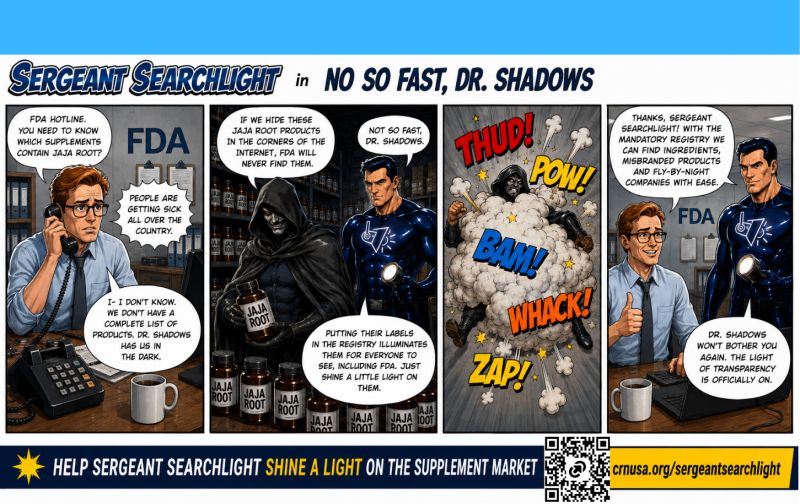
CRN launched the Sergeant Searchlight campaign to support the Dietary Supplement Listing Act, translating a technical policy issue into a clear message for lawmakers: FDA needs visibility into products on the market to strengthen oversight, improve transparency and support responsible companies. In advance of its Day on the Hill fly-in June 11, CRN canvassed Capitol Hill with Sergeant Searchlight’s messaging on how the Dietary Supplement Listing Act shines a light on what matters and mitigates “The Aisle of Darkness,” a critical gap in the current system: there is no comprehensive, product registry of dietary supplements currently on the market.

CRN pushes for transparency, consistency in supplement regulation
As lawmakers examined several food policy proposals during an April House Energy and Commerce Health Subcommittee hearing, CRN submitted a statement for the record highlighting how dietary supplements support public health and where policymakers should focus to strengthen oversight without disrupting consumer access.
CRN supports legislation advancing regulatory uniformity and HSA/FSA eligibility for dietary supplements
CRN continued its advocacy for regulatory uniformity during meetings with Capitol Hill staff, following its public support of the Dietary Supplement Regulatory Uniformity Act introduced earlier this year. If enacted the act would restore clarity by affirming that only FDA can establish regulatory requirements for dietary supplements, while still allowing states to petition the agency if they can demonstrate a legitimate local concern. This balanced approach preserves flexibility without sacrificing consistency or scientific rigor. Importantly, the legislation does not prevent states from enforcing identical state versions of federal requirements to supplement federal oversight with their own enforcement resources.
CRN also applauded the introduction of the bicameral Dietary Supplements Access Act, legislation that would amend the Internal Revenue Code to recognize dietary supplements as qualified medical expenses eligible for reimbursement through Health Savings Accounts (HSAs), Flexible Spending Arrangements (FSAs), Health Reimbursement Arrangements (HRAs), and Archer Medical Savings Accounts (MSAs). CRN has long advocated for policies that expand consumer access to preventive health tools, including reforms to tax-advantaged healthcare spending accounts. For more than two decades, the association has supported legislative and regulatory efforts to modernize HSA and FSA eligibility rules and ensure consumers can use these accounts for evidence-based nutritional products that promote health and wellness.
CRN pushes for practical, science-based oversight and standards
CRN submitted comments urging FDA to modernize its interpretation of “dietary ingredient” following association leadership's engagement in the agency's public meeting in March. In addition, CRN submitted comments asking FTC to avoid expanding its Negative Option Rule in ways that could expose supplement companies to unfair legal risk for truthful, science-based claims.
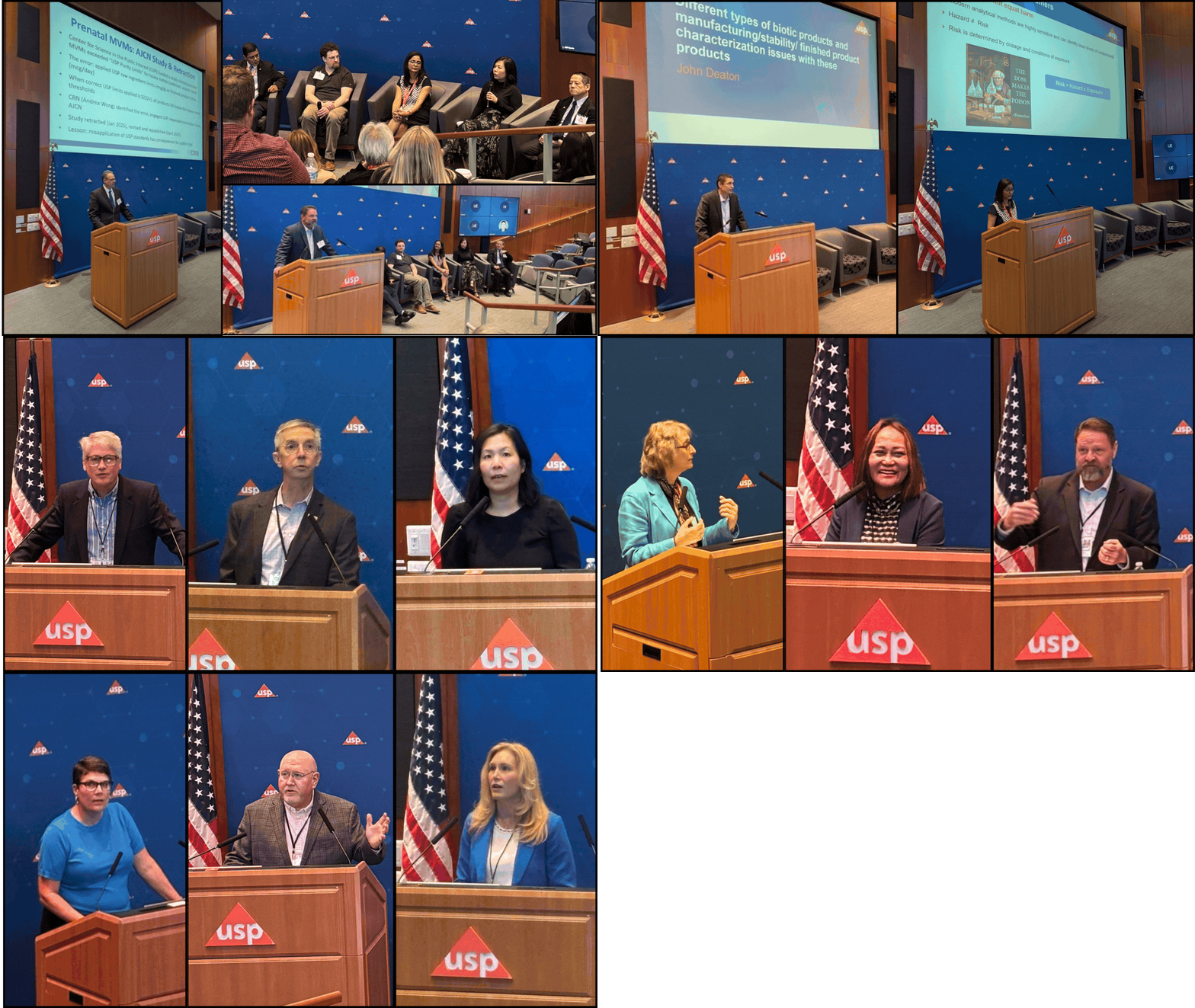
CRN also collaborated with industry stakeholders at associate member USP's Dietary Supplement Stakeholder Forum and the inaugural East Coast SoCal Dietary Supplement Consortium event, with discussions focused on dietary supplement safety, quality, testing, and compliance. CRN’s Luke Huber, N.D., MPH, VP of scientific & global affairs, chaired the USP forum’s planning committee and delivered opening and closing remarks and Andrea Wong, Ph.D., SVP & chief science officer, also participated as a panelist in a session focused on heavy metal exposure and testing. CRN was proud to serve as a sponsor of the SoCal Dietary Supplement Consortium with CRN President & CEO Steve Mister offering remarks. Read more in the CRN Supplement newsletter.
BUILDING CREDIBILITY, STRENGTHENING TRUST
CRN's science-based prenatal nutrition resources resonate at ACOG
The CRN Foundation's Prenatal Nutrition Center and a standing-room-only session at the American College of Obstetricians and Gynecologists (ACOG) Clinical and Scientific Meeting addressed the growing demand for credible, evidence-based nutrition education on prenatal health.
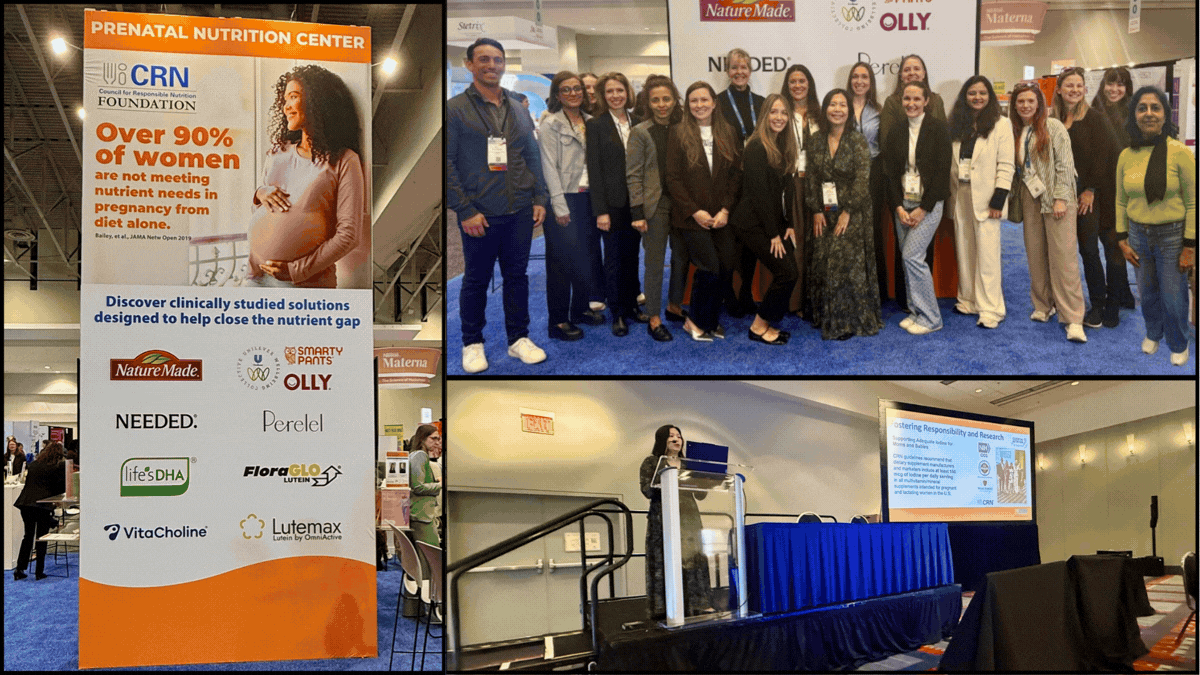
CRN's Andrea Wong, Ph.D., wrote in a recent SupplySide Supplement Journal article, "This kind of engagement doesn’t happen in a vacuum. It reflects a coordinated effort by CRN member companies and partners who share a common goal: advancing maternal and infant health through better nutrition." She noted that clinicians wanted to understand not only what the evidence says, but how to translate it into real-world practice. "They were candid about the challenges they face, from time constraints during patient visits to the lack of nutrition training in many medical education programs," Dr. Wong wrote.
That last point deserves particular attention, Dr. Wong noted. "For years, healthcare professionals have told us they want more robust education in nutrition. The strong turnout at our Prenatal Nutrition Center—and the overflow crowds at the workshop—underscore just how significant that demand has become. It’s not an exaggeration to say that we are seeing a shift: Nutrition is moving from the margins to the mainstream of clinical care."
CRN equips members, regulators with science-based responses putting supplement news in context
CRN provided members-only talking points on a study published in Nature Metabolism examining glucosamine use and Alzheimer's disease progression which received considerable attention from consumer and trade media outlets, including a widely shared Newsweek article and subsequent coverage that has, in some cases, characterized the findings in ways that may overstate the study's conclusions. View details on the study in CRN's recent interim alert. Access CRN's standby statement and talking points document here.
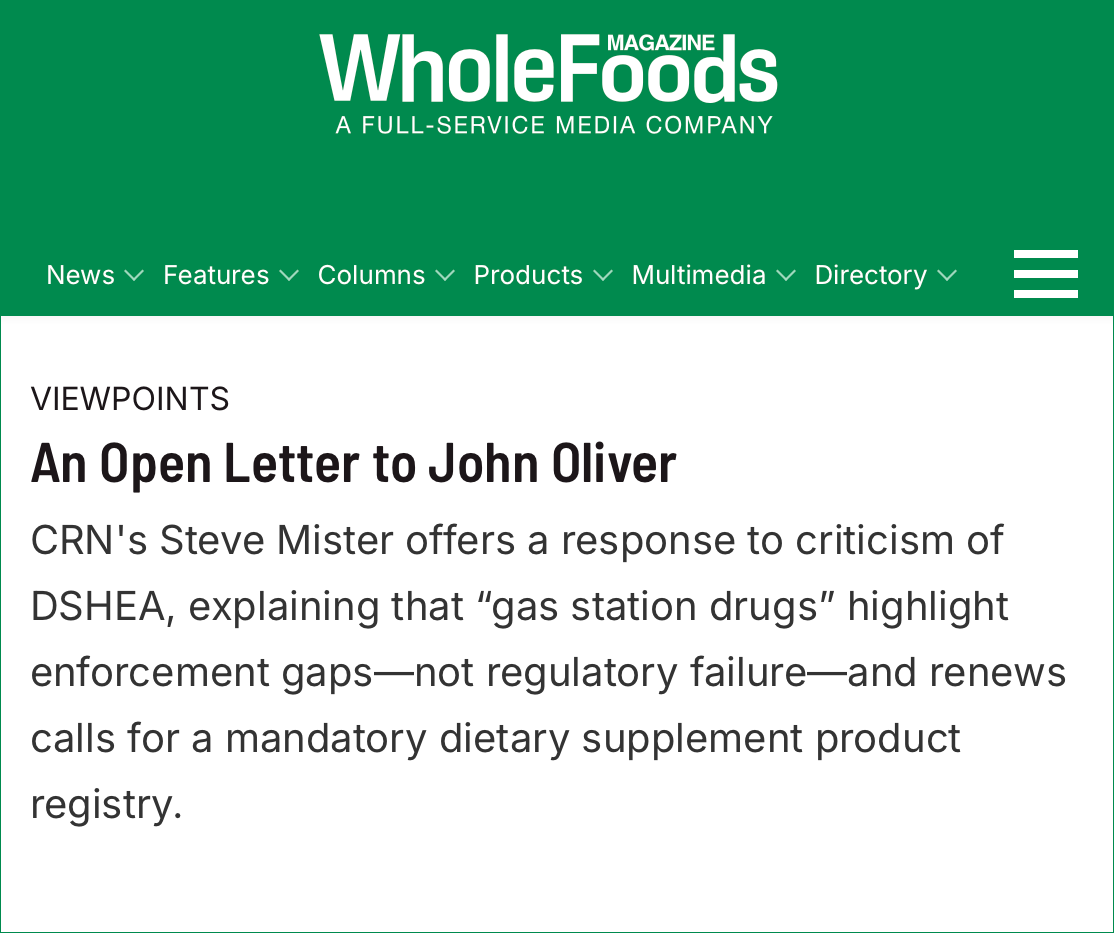 CRN pushed back on mischaracterizations of dietary supplements made on the show "Last Week Tonight with John Oliver" through an open letter published in Whole Foods Magazine. CRN noted, "Blaming DSHEA for illegal products is like blaming speed limit signs for reckless drivers. The problem is not that rules don’t exist. The problem is that bad actors have conclude—often correctly—that nobody is enforcing them consistently enough to create real deterrence." CRN differentiated the illegal "gas station heroin" products being misrepresented as supplements, explaining that FDA already has authority to act against adulterated and misbranded products. "The agency can seize products, issue injunctions, pursue criminal sanctions, and shut facilities down. The problem is not that FDA lacks authority. The problem is that enforcement has too often been sporadic, reactive, and overwhelmed by a rapidly growing gray market." CRN further advised, "One practical step forward would be a mandatory product registry for dietary supplements. At minimum, it would give FDA visibility into the universe of products being marketed as supplements and help distinguish legitimate products from sketchy chemistry experiments with names like “Black Panther” and “Super Bull Titanium Rhino Maximum.”
Separately, CRN urged regulators to take an evidence-based approach to vitamin B6 safety as international scrutiny increased. Some countries have tightened limits and labeling requirements for vitamin B6-containing products based on peripheral neuropathy. For example, EFSA set a new tolerable upper intake level (UL) for vitamin B6 of 12.5 mg per day for adults in 2023, down from 30 mg per day. CRN’s updated Vitamin and Mineral Safety reference for vitamin B6 established an upper level for supplementation of 100 mg per day. CRN’s senior vice president and chief science officer, Dr. Andrea Wong emphasized that credible human studies have shown neuropathy associated with vitamin B6 supplementation typically occurs at substantially higher intake levels—above 200 mg per day and often much higher, as discussed in a recent NutraIngredients-USA article. Dr. Wong cautioned that setting ULs too low could create unintended consequences, including reformulations that may make products less effective for individuals with legitimate nutritional needs. CRN continues to support responsible oversight and consumer education, while urging regulators to base vitamin B6 policies on current, relevant science and the full weight of the evidence.
LEADING MEMBERS THROUGH TRADE AND STATE POLICY CHALLENGES
CRN helps companies assess tariff exposure and supply chain risk
As trade policy shifted rapidly throughout Q2, CRN helped members understand potential business impacts and prepare for changing import conditions. CRN briefed members on tariff refund litigation, Section 301 investigations involving forced labor enforcement and manufacturing overcapacity, proposed tariffs on Brazilian goods, and Section 232 metals tariff changes. CRN also urged USTR to exclude dietary supplements, functional foods, and ingredients from tariff actions, helping companies evaluate sourcing, entry data, refund opportunities, import costs, and supply chain risk. See the most recent update for CRN members (as of this Q2 report) in the Interim Alert here.
CRN responds to state legislative proposals on age-restrictions, labeling and more
CRN remained deeply engaged as state legislatures considered proposals that could restrict consumer access or complicate national compliance. CRN opposed age-restriction proposals in states including California, Connecticut, Delaware, Massachusetts, Ohio, and Rhode Island, while monitoring similar activity nationwide. These proposals included restrictions on weight-management and muscle-building supplements, energy drinks, and caffeinated supplements. CRN's work helped ensure policymakers heard directly from the responsible supplement industry about the risks of overbroad restrictions and the importance of science-based policy.
Beyond age restrictions, CRN sought dietary supplement carve-outs or clarifications in state proposals involving date labeling, GRAS, protein testing, packaging, and Extended Producer Responsibility (EPR) requirements. These issues matter because even well-intended state legislation can create conflicting obligations for companies operating in a national marketplace. CRN's advocacy helps protect regulatory consistency, reduce unnecessary compliance costs, and preserve consumer access to lawful products.
HELPING MEMBERS STAY AHEAD OF CHANGE
CRN convenes members for discussion, guidance on Extended Producer Responsibility
EPR and packaging requirements continued to be a growing concern for supplement companies during the quarter. As EPR laws moved forward in California, Colorado, Maine, Maryland, Minnesota, Oregon, and Washington, CRN kept members informed on producer obligations, producer responsibility organization registration, exemptions, and implementation timelines.
CRN also held an EPR Forum to help members better understand evolving packaging requirements and share practical compliance considerations. CRN invited Rachel Bond, Partner at Keller & Heckman, to provide an introduction. Her slide deck can be viewed here.
CRN leaders help shape discussions on FDA modernization, regulatory uncertainty, and the evolving compliance landscape
As companies prepare for continually evolving regulatory expectations, requiring more agile responses, stronger cross-functional collaboration, and proactive compliance planning, CRN co-presented its 14th Annual Legal, Regulatory & Compliance Forum with expert guidance and insights from FDA and FTC officials.
One of the conference's signature sessions featured a keynote conversation between CRN Senior Vice President & Chief Science Officer Andrea Wong, Ph.D., and Cara Welch, Ph.D., director of FDA's Office of Dietary Supplement Programs. The discussion offered attendees valuable perspectives on FDA's current priorities, ongoing efforts to modernize dietary supplement oversight, and the scientific and regulatory issues expected to influence the agency's work in the years ahead.
FDA modernization remained a central theme throughout the conference.
CRN webinars provide member education on science, communications topics
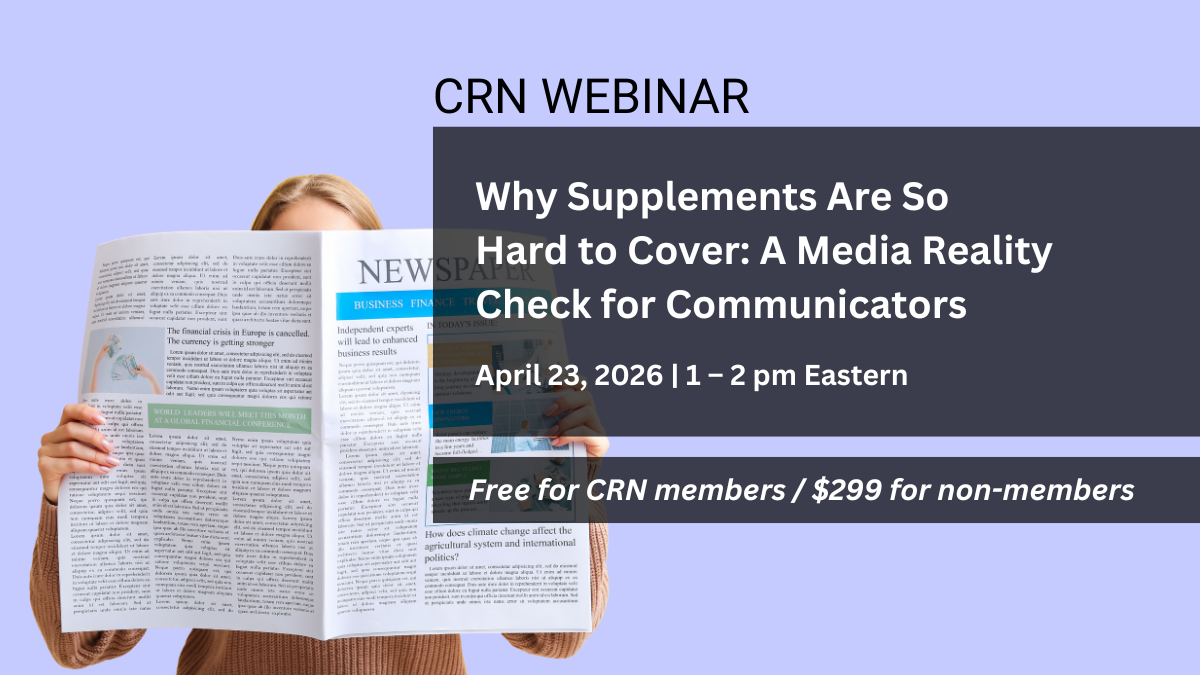
CRN presented webinars offering a media reality check for communicators on why supplements are so hard to cover, and on the use of new approach methodologies in the safety assessment of dietary supplements, available on demand.
In addition to webinars, CRN committee calls often have guest presenters, such as the Regulatory Affairs Committee's April call with Julie Catzalco, Manager of Analytical Research Services at Pharmavite, discussing Standard Method Requirements for Heavy Metals Testing in Dietary Supplements. See her recorded presentation and slides.

COMING UP THIS FALL:

Registration today for our 2026 Signature Events, Oct. 6–8, at the Westin Carlsbad Resort & Spa
Secure your place at CRN's signature events and gain access to the conversations driving industry growth.
Meet the people shaping science, policy, innovation, and consumer trust.
Join us to connect with top industry leaders to cultivate the insights, relationships, and strategies that position your company for success.
Learn more and register here.