
JULY – SEPT 2026
Quarterly Results Report
During the third quarter, CRN turned member priorities into policy progress, practical guidance and stronger platforms for the future. CRN secured a California labeling exemption, advanced federal drug-preclusion reform, helped companies navigate fast-changing requirements, strengthened science and public trust, and worked with association leaders to establish Vision 2030.
Download the printable PDF summary of the Q3 2026 report.
Q3 2026 AT A GLANCE — CRN:
- Built a shared strategic roadmap for the next three years, Vision 2030
- Delivered policy results that will reduce business risk, advance innovation and defend consumer access
- Shaped more workable regulation through engagement on GRAS reform, protein-powder oversight and FDA inspections
- Protected critical supply chains while advancing supplement access and consistent national standards
- Strengthened consumer trust through CRN’s promotion of emerging science, responsible-industry advocacy and community impact
- Connected members with timely intelligence, expert programming and new business relationships
SETTING CRN'S DIRECTION THROUGH VISION 2030
CRN Executive Committee, staff build shared strategic roadmap
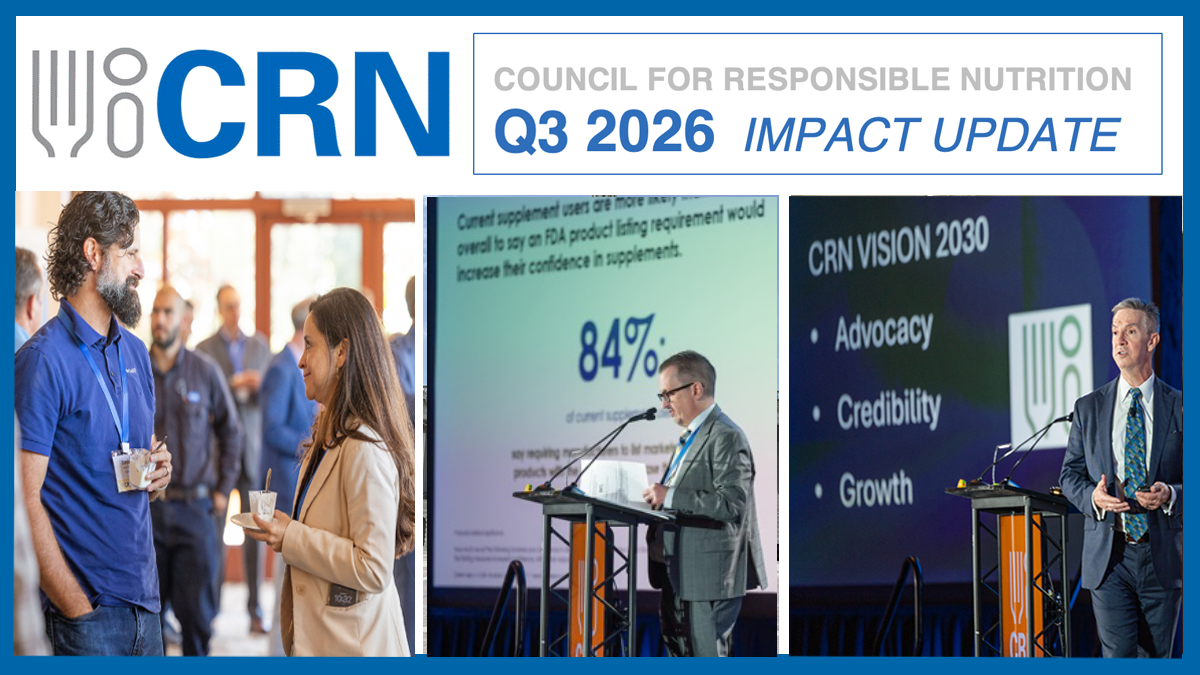
A newly adopted strategic plan, Vision 2030, connects CRN's day-to-day work to shared long-term choices about where the association should invest, how it will strengthen the responsible industry and how it will deliver value over the next three years. In early Q3, Senior staff and the Executive Committee of the Board of Directors participated in a dedicated strategic-planning process, considering lessons from the 2024–2026 plan's execution and future recommendations to refine CRN's mission, vision, strategic priorities and the organizational capacity required to deliver them. At its September meeting, the Board unanimously adopted the resulting Vision 2030, with a refreshed mission, "To protect and grow the responsible dietary supplement and functional food industry," and which is organized under three strategic objectives:
- ADVOCACY—Representing the collective interests of members to lawmakers, regulators, and other policy stakeholders.
- CREDIBILITY—Strengthening public trust through responsible leadership, credible science, and reliable information.
- GROWTH—Providing the information, education, and connections members need to grow and thrive.
Vision 2030 also calls for diversified revenue, stronger membership value and recruitment, better use of the CRN Foundation's reach and 501(c)(3) status, and continued investment in staff expertise and capacity.

ADVANCING POLICY WITH BUSINESS IMPACT
CRN saved industry from costly label changes, securing supplement exemption in new California law
CRN's advocacy secured an exemption for dietary supplements from California's new food date-labeling requirements. CRN stayed engaged from the original AB 660 debate through implementation questions, including contact with Amazon when its communications raised concerns that supplement labels might need to change. CRN advocated for AB 2779 to put the intended supplement exemption expressly into the law. California's enactment of AB 2779 kept supplements outside a date-labeling system designed for conventional foods. Through CRN's efforts, companies avoided potentially costly label changes, and consumers retain expiration dating that communicates supplement shelf life and potency.

CRN-supported drug preclusion reform legislation introduced in Congress
A long-standing CRN priority now has a legislative vehicle that can reduce uncertainty, support responsible innovation and preserve consumer access. CRN worked with allied trade associations and Rep. Diana Harshbarger to develop the Dietary Supplement Innovation Act, a bill to rebalance the interests of drugs and supplements more equitably. Introduced Sept. 9, the bill would protect ingredients marketed before DSHEA, address discontinued or inactive drug-development programs and create a clearer FDA pathway for ingredients used in both drugs and supplements. CRN is continuing to coordinate advocacy efforts among select trade groups and other stakeholders, including outreach to potential cosponsors, a “Dear Colleague” letter, and identifying a Democratic co-lead.

CRN continued to oppose misplaced, sweeping age restrictions
CRN persisted in its sustained campaign against California AB 2030, providing testimony, submitting formal opposition letters, engaging directly with legislative and administration officials, equipping members to reinforce the industry’s concerns, and formally requesting a gubernatorial veto.
Despite those efforts, Gov. Gavin Newsom signed AB 2030 into law in September. CRN warned that the bill’s reliance on broad marketing language and common ingredients—rather than evidence that specific products present a public-health risk—could restrict lawful supplements, confuse consumers and create significant uncertainty for responsible businesses.
CRN immediately clarified the law’s potential impact for members and consumers and committed to continued advocacy as implementation moves forward. The California measure also reflects a broader campaign to impose age restrictions on weight-management and sports-nutrition supplements, making CRN’s related work in New York, New Jersey and other states increasingly important.
CRN will continue working with lawmakers, regulators and other stakeholders to promote responsible, evidence-based policies that protect consumers without unnecessarily restricting access to lawful dietary supplements
CRN advanced its challenge to New York’s age-restriction law
CRN in its litigation against the state of New York, continued seeking U.S. Supreme Court review of the state's supplement age-restriction law passed in 2023, restricting supplement sales based on how products are marketed, labeled or otherwise represented—not on a determination that the products are unsafe. CRN argued that the law infringes on First Amendment protections for truthful commercial speech and could establish a damaging model for other states. CRN filed its cert-petition reply brief just prior to Q3, but received notification in early Q4 that the Court declined to review its challenge. The case now moves forward at the district court.
CRN alerted members as New Jersey considered similar restrictions
When New Jersey introduced its own dietary-supplement age-restriction legislation in September, CRN alerted members and began evaluating the proposal and preparing its response. Early engagement gives CRN and its members an opportunity to educate policymakers before another broadly drafted measure gains momentum.
SHAPING SMARTER, MORE CONSISTENT POLICY
CRN prepared members for FDA GRAS reform
CRN convened its Regulatory Affairs Committee and Self-GRAS Task Force to evaluate the implications of FDA’s proposed changes to the Generally Recognized as Safe (GRAS) process, potentially eliminating the current self-GRAS pathway. The Task Force is developing an alternative streamlined notification proposal for comments due in Q4. The team also prepared for a half-day virtual workshop presented in Q4, GRAS Reform in Transition: Preparing the Industry for Changes.

CRN brought responsible-industry context to the Texas protein-powder probe
 CRN responded to a Texas Attorney General investigation into protein powders that alleged harmful heavy-metal contamination and questioned if companies had misrepresented product safety. CRN’s response emphasized federal manufacturing, testing and labeling requirements and the importance of evaluating findings against established, science-based standards. In addition, CRN cautioned the AG’s office against proceeding with an investigation based on the headline-grabbing tests of consumer organizations whose agenda is to identify the “best” and “worst” products available to consumers, not to ascertain unsafe or violative products. CRN noted that a product that does not receive a “buy” recommendation from one of these groups may be perfectly lawful and that it would be imprudent to presume that a product that contains detectible levels of a heavy metal is presumptively harmful or unlawful.
CRN pressed FDA for clarity on inspection changes
CRN formally asked FDA to explain how its planned “Simple Reform” reorganization will affect inspections of human food and dietary supplement facilities. Dietary supplements, conventional foods and drugs have different regulatory frameworks and good manufacturing practice requirements. CRN cautioned that moving away from product-specific expertise could undermine the consistency and effectiveness of FDA inspections. Read CRN’s full letter to FDA here.
PROTECTING SUPPLY CHAINS AND ADVANCING INDUSTRY PRIORITIES NATIONALLY
CRN submitted official comments on trade actions affecting the supplement industry
CRN filed comments with the U.S. Trade Representative (USTR) in response to actions with potential impact on dietary supplement and functional food ingredient supply chains. CRN emphasized in all of the filings that many supplement and functional food ingredients are not available domestically at commercial scale and that maintaining stable access to these inputs protects U.S.-based manufacturing, keeps products affordable, and supports the health and wellness of the 75% of American adults who use dietary supplements.
Responding to proposed Section 301 action involving forced-labor enforcement, CRN reviewed 105 supplement- and functional food-related tariff classifications. CRN urged USTR to retain proposed exemptions for 63 classifications, broaden two partial exemptions and add exemptions for the remaining 40.
In separate comments on a proposed reciprocal-trade mechanism with China, CRN identified priority vitamin inputs and other dietary ingredients as nonsensitive consumer-health goods that should be considered for favorable tariff treatment. CRN emphasized that many of these ingredients are not available domestically at commercial scale and that reliable access supports U.S. manufacturing, product availability and affordability.
CRN also responded to USTR’s Section 301 investigation into Brazil’s trade practices, which could result in additional tariffs on Brazilian imports. Brazil is a critical supplier of supplement ingredients—most notably bovine collagen, for which it represents nearly 40% of the global supply—and U.S. production cannot meet commercial demand. CRN urged USTR to retain exemptions for 62 relevant tariff classifications, broaden two partial exemptions and add 41 more, including bovine collagen. This advocacy sought to prevent trade remedies aimed at Brazil from increasing costs for U.S. manufacturers, threatening American jobs or disrupting consumer access to finished products.
As other trade policies changed, CRN also helped members assess the implications of new U.S.–Canada tariffs and counter-tariffs.
CRN continued advancing expanded supplement access
Following the May introduction of the Dietary Supplements Access Act, CRN continued advocating for legislation that would allow consumers to use HSA and FSA funds to purchase dietary supplements. Reps. Beth Van Duyne and Mike Carey joined the Dietary Supplements Access Act as cosponsors during Q3, while a separate healthcare package introduced in August included another proposal to extend HSA eligibility to supplements. CRN also continued engaging Congress and the Administration through its dual-track strategy for expanding access.
CRN equipped members to advance industry priorities in their congressional districts
CRN encouraged member companies to participate in “Day in the District” advocacy during congressional recesses, providing resources to help companies arrange meetings, host facility visits and engage elected officials at home. The initiative gave members practical ways to explain their businesses and products while building support for marketplace transparency, HSA/FSA access and legislation affirming a consistent federal regulatory framework for dietary supplements.
CRN advanced clearer national recycling standards
CRN supported House committee progress on the Recycled Materials Attribution Act and the PACK Act. Both measures would help establish more consistent national approaches to recycling claims and packaging policy, reducing the risk of conflicting state requirements for companies operating nationwide. CRN is actively engaged on this issue as the only dietary supplement trade association represented on the Recycling Leadership Council, a cross-industry coalition endorsing the legislation and working to advance clear, consistent national recycling standards. CRN will continue to monitor developments and update members on any implications for the dietary supplement industry.
BUILDING TRUST THROUGH SCIENCE AND RESPONSIBILITY
CRN expanded access to emerging nutrition science
CRN convened its Innovation Exchange Steering Committee to review submissions for the showcase spotlighting innovative research, technologies, and ingredients within the interactive setting of CRN’s annual industry gathering. Innovation Exchange took place in October—on-demand recording access is available here.

CRN launched its Science Forward virtual trade show series with an inaugural program examining bacteriophages and their emerging role in gut health. The series will connect researchers, product developers and other industry professionals with developing areas of science that may shape future innovation, communication and policy.
CRN held a webinar on "Next-Generation Peptides: Emerging Science, Innovation, and Opportunities for Dietary Supplements," exploring the evolving science behind bioactive peptides, translational opportunities for dietary supplements, and the regulatory and commercialization considerations shaping the future of peptide-based nutrition products.

CRN-International opened a symposium series, "Next-Generation Nutrients: Advancing Nutrition Science Throughout the Lifespan," on Sept. 15. The inaugural program on nicotinamide riboside attracted 142 registrants and set the stage for additional sessions in Q4 on omega-3s, choline, and lutein and zeaxanthin. The hybrid session on choline occurs along with an in-person breakfast alongside the Codex Committee on Nutrition and Foods for Special Dietary Uses (CCNFSDU45) in Germany. Planned publication of the proceedings will extend the program’s value by contributing to the peer-reviewed scientific literature.

CRN distinguished illegal injectable peptides from lawful supplements
As media and regulatory attention intensified around injectable peptides sold outside lawful channels, CRN clarified in a statement that these products should not be confused with legally marketed dietary supplements. CRN emphasized that injectable products do not meet the statutory definition of a dietary supplement and called for stronger enforcement against companies selling unapproved drugs. By drawing that distinction, CRN defended responsible supplement companies while supporting action against products that may put consumers at risk.
CRN challenged AI-generated health deception
CRN spoke out against the use of fabricated health experts, deceptive advertising and AI-generated content to promote products through illegal disease claims. The association called for stronger enforcement and greater accountability from the online platforms that allow this content to reach consumers. CRN’s response reinforced that deceptive digital marketing violates existing law and should not be treated as representative of responsible dietary supplement practices.
CRN added context to prenatal-vitamin testing
CRN responded to Consumer Reports as it examined nutrient levels and label accuracy in prenatal supplements, providing scientific and regulatory context before and after publication. CRN acknowledged the legitimate questions raised by the testing while cautioning against conclusions that failed to account for established testing methods, nutrient forms, serving directions and the complexities of prenatal formulation. This engagement helped ensure that coverage more accurately distinguished meaningful product-quality concerns from findings that could unnecessarily alarm consumers.
CRN generated new consumer insights to strengthen trust and inform advocacy
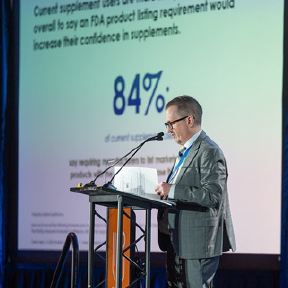 CRN fielded its 2026 national consumer survey with Morning Consult Sept. 11–13, gathering responses from 3,005 U.S. adults about supplement use, affordability and the factors that build consumer confidence. The findings, presented at CONVERGENCE '26, showed that 75% of U.S. adults use dietary supplements and that consumers place significant value on scientific evidence, credible information, product quality and effective enforcement.
The research also provided timely support for CRN’s policy priorities. Seventy-six percent of adults said requiring manufacturers to list marketed dietary supplement products with FDA would increase their confidence at least somewhat, adding an important consumer perspective to CRN’s longstanding support for a federal product registry. The complete data set will give members deeper insight into consumer attitudes, purchasing pressures and the factors influencing supplement use.
CRN connected industry resources with communities in need
Through the CRN Foundation’s Access Initiative, CRN helped connect Stratum Nutrition and Vitaquest’s VQ Cares program with free and charitable clinics serving patients in Missouri. The collaboration provided 10,000 bottles of adult multivitamins to clinics reaching people who may understand the value of dietary supplements but lack the financial means to purchase them.
The contribution demonstrates how ingredient suppliers, manufacturers, the CRN Foundation and community health partners can combine their capabilities to expand access to nutrition resources.
CONNECTING MEMBERS TO INFORMATION AND OPPORTUNITY
CRN connected members with timely trade expertise
As tariff policy continued to change, CRN kept members informed about developments affecting imported ingredients and finished products. As an added member service, CRN connected members with specialized trade expertise, including an associate-member briefing on the evolving IEEPA tariff-refund landscape.
CRN extended year-round access to industry expertise
CRN released seven new Supplement Source podcast episodes covering sustainability, emerging nutrition science, responsible marketing, product safety and compliance, cardiovascular research, and industry leadership. Associate-member spotlights provided additional perspectives on regulatory developments, business strategy, research and evolving marketplace risks.
Together with CRN’s newsletter, committee alerts and growing library of on-demand resources, these programs gave members continuing access to information and expertise beyond scheduled meetings and conferences.
CRN built stronger forums for science, strategy and leadership
CRN finalized programming for SciComms Connect, Innovation Exchange and CONVERGENCE '26, held in October. The programs brought together perspectives on women’s health, emerging research, FDA priorities, state regulation, artificial intelligence, workforce strategy, political developments and the business decisions shaping the industry. See recaps of select sessions and press coverage here.


CRN also convened retail leaders at the National Association of Chain Drug Stores (NACDS) Total Store Expo for a breakfast briefing focused on consumer trends and the expanding role of pharmacists in supplement education. From GLP-1 support to women’s health issues to longevity, pharmacists are more engaged helping consumers navigate the supplement aisle. That means more opportunities for education and promotion to the nation’s “most accessible health professionals.” Speakers reminded our members’ sales teams that, as online sales and social media marketing explode, face-to-face, instore encounters can still provide the health coaching and assistance with product selection that so many consumers are looking for.

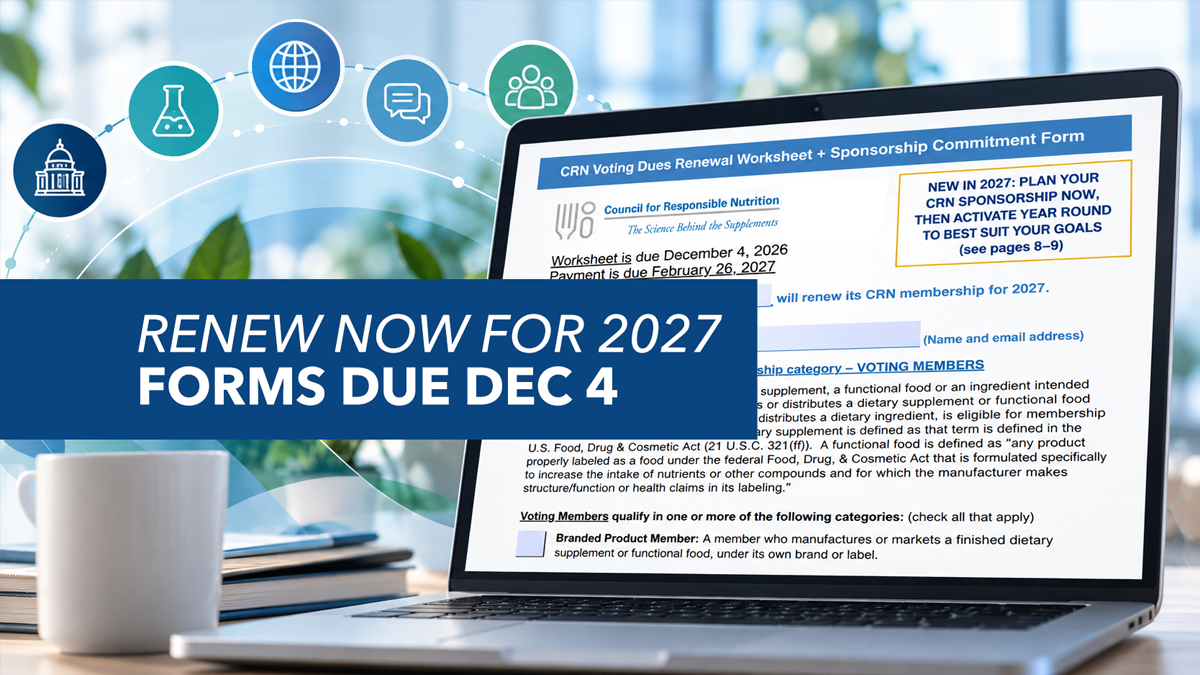
2027 CRN membership renewal and sponsorship commitment drive now underway—see renewal details
Not a member yet? Learn how to join the CRN community to strengthen your business and support effective industry-advancing initiatives.