

December 11, 2025
WASHINGTON D.C. — The Council for Responsible Nutrition (CRN), the leading trade association for the dietary supplement and functional food industry, today commended the U.S. Food and Drug Administration (FDA) and expressed the association’s appreciation for FDA providing needed clarity on the placement of the Dietary Supplement Health and Education Act (DSHEA) disclaimer on product labels.
For nearly 30 years, FDA practice has allowed the use of an asterisk to direct consumers to the full DSHEA disclaimer elsewhere on the label, consistent with section 403(r)(6)(C) of the Food, Drug & Cosmetic Act and 21 C.F.R. § 101.93(d). However, a recent uptick in class-action lawsuits has relied on an alternative interpretation, arguing that the full disclaimer must be placed on every panel where a structure/function claim is used on a product label. These legal challenges have created confusion, prompted unnecessary litigation, and imposed costly and disproportionate burdens on responsible manufacturers—without improving consumer understanding.
Earlier this year, CRN called on FDA [starting on page 23] to revise section 101.93(d) to clarify that the law does not require duplicative use of the DSHEA disclaimer on multiple panels of the same product. CRN offered then that making the change “would maintain adequate levels of consumer protection while reducing unnecessary, redundant regulatory burdens on companies,” and argued that a single disclaimer on a dietary supplement product’s label linked by an asterisk or other symbol to structure/function claims adequately informs consumers of the existence of additional information and satisfies the legislative intent to have a structure/function statement “contain” the disclaimer. Separately, CRN made clear to the agency that it was prepared to file a citizen petition to formally escalate the matter if needed.
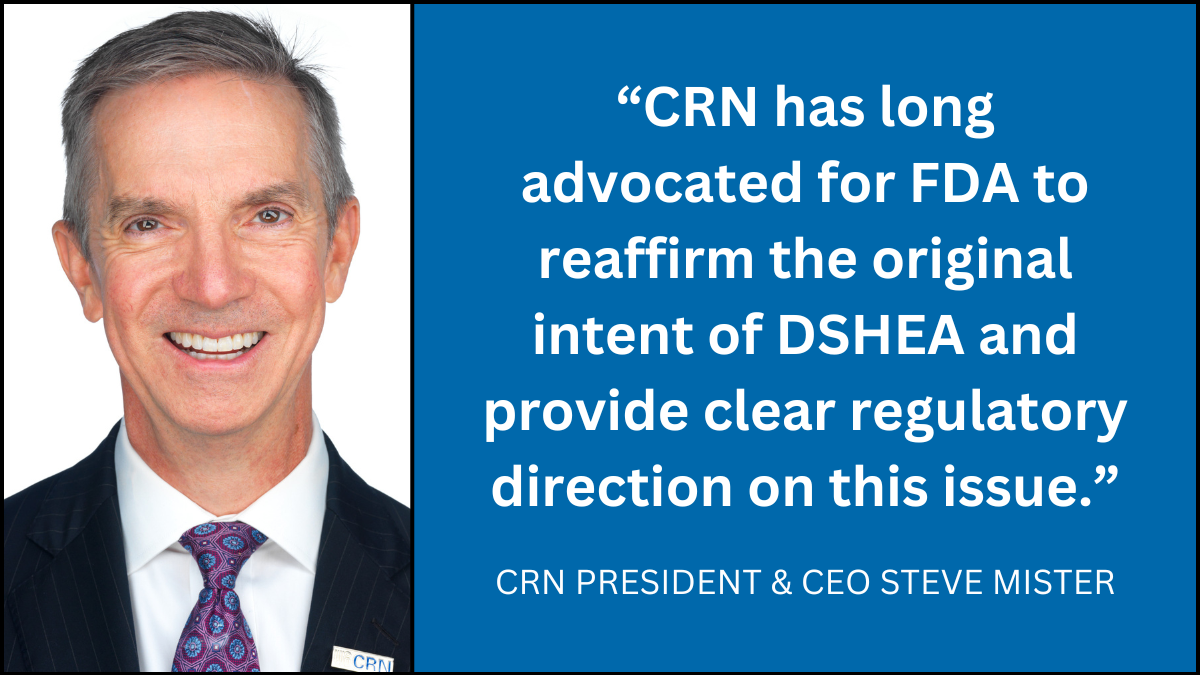
“CRN has long advocated for FDA to reaffirm the original intent of DSHEA and provide clear regulatory direction on this issue,” said CRN President & CEO Steve Mister. “We welcome FDA’s attention to this matter and appreciate the opportunity to support the agency in recognizing the practical, commonsense approach that consumers and companies have relied on for nearly three decades. Consistency in labeling standards strengthens consumer confidence and supports a stable regulatory environment.”
“This clarification is in alignment with the statute and eliminates ambiguity that has fueled opportunistic litigation,” said Megan Olsen, Senior Vice President and General Counsel, CRN. “For years, FDA’s implementation has allowed companies to use an asterisk to direct consumers to the disclaimer, and that approach is fully consistent with DSHEA. Clear guidance helps ensure that companies can meet their obligations without unnecessary litigation risk, while still providing consumers with accurate, meaningful information. We appreciate FDA’s willingness to revisit this issue and apply a clear, legally sound interpretation moving forward.”
CRN views this outcome as a meaningful step toward regulatory clarity that benefits both the marketplace and the millions of Americans who rely on dietary supplements every day for better health. It supports compliance, consumer access, and marketplace trust.
About the Council for Responsible Nutrition (CRN)
The Council for Responsible Nutrition (CRN), founded in 1973, is a Washington, D.C.-based trade association representing 180+ dietary supplement and functional food manufacturers, ingredient suppliers, and companies providing services to those manufacturers and suppliers. In addition to complying with a host of federal and state regulations governing dietary supplements and food in the areas of manufacturing, marketing, quality control and safety, our manufacturer and supplier members also agree to adhere to additional voluntary guidelines as well as to CRN’s Code of Ethics. Follow us on X @CRN_Supplements and LinkedIn.